


Service Dog vs Emotional Support Animal: Full Legal Differences in the USA | Modest Dog US
The distinction between a service dog vs an emotional support animal in USA is often misunderstood, even by individuals who actively rely on animal support in their daily lives. While both can play an important role, they operate under entirely different legal and functional frameworks.
This confusion typically surfaces in real situations—housing applications, public access disputes, or when documentation is reviewed more carefully than expected. In many of these cases, the issue is not the need itself, but the classification and how it has been presented.
Understanding these differences allows you to make the right decision from the beginning and avoid unnecessary complications later.
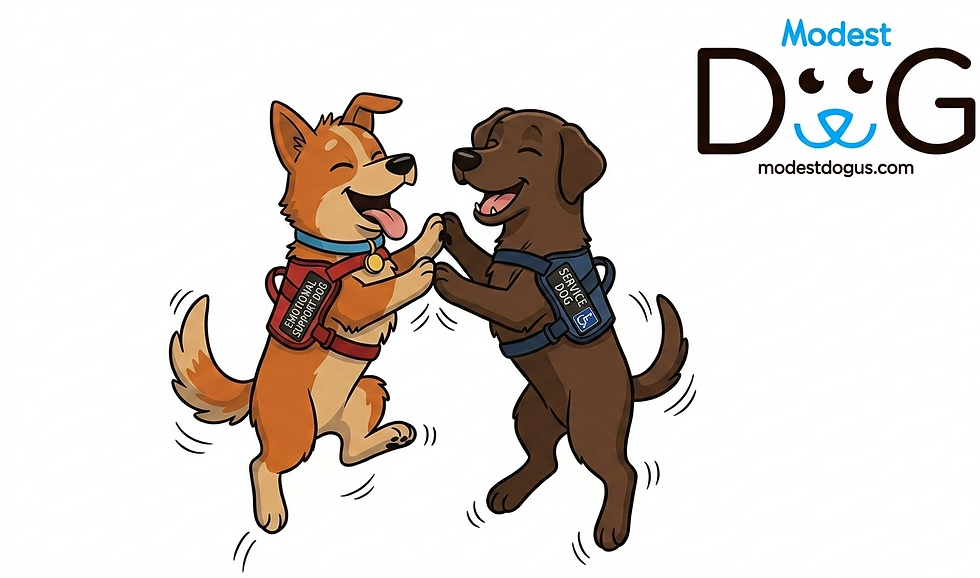
What Defines a Service Dog Under U.S. Regulations
A service dog is defined by function, not by companionship. Under federal guidelines, these animals must be trained to perform specific tasks directly related to a person’s disability.
This requirement changes everything. It means that a service dog is expected to respond reliably in real-world environments, not just controlled settings. Key elements that define a service dog:
Task-specific training linked to a disability
Consistent behavior in public environments
Ability to assist in practical, functional ways
Recognition under federal regulations such as ADA
In practice, this is what grants service dogs their broader access rights.
What Is an Emotional Support Animal (ESA)?
An emotional support animal provides psychological or emotional comfort through companionship rather than trained tasks.
Unlike service dogs, ESAs do not require specialized training, but they still play an important role in supporting mental health. Key characteristics of an ESA:
Provides emotional stability and comfort
Does not require task-specific training
Requires proper documentation for recognition
Primarily relevant in housing situations
While more accessible than service dogs, ESAs operate under a more limited legal framework.
Functional Differences That Impact Daily Life
The real difference between these two categories becomes clear in everyday situations.
A service dog is expected to operate seamlessly in public environments. This includes remaining calm, focused, and responsive even in crowded or unpredictable settings.
An emotional support animal, on the other hand, is not held to these same standards. Its role is more personal and typically limited to private or residential environments.
In practical terms:
Service dogs are trained to act → ESAs provide presence
Service dogs adapt to public environments → ESAs are not required to
Expectations for behavior are significantly higher for service dogs
Understanding this distinction helps prevent unrealistic expectations, especially in public spaces.
Legal Scope: Public Access vs Housing Protections
One of the most critical differences lies in legal recognition.
Service dogs are granted access to most public spaces because they are considered essential for daily functioning. Emotional support animals do not fall under the same category.
Here’s how the legal scope differs:
Service Dogs:
Allowed in restaurants, stores, and public areas
Protected under ADA regulations
Not subject to pet restrictions or fees
Emotional Support Animals:
Primarily protected under housing regulations
No guaranteed access to public places
May require documentation for approval
This is where most misunderstandings occur—assuming that all support animals share the same rights.

Training Requirements: Expectations and Behavioral Standards
Training is a defining factor between both categories, but it is often misunderstood.
A service dog must be trained to perform tasks and maintain a high level of behavioral control. This includes responding consistently regardless of distractions. In contrast, emotional support animals are not required to undergo formal training programs.
That said, behavior still matters. Even without formal training requirements, an ESA that causes disturbances in a housing environment can create complications for its owner.
Training is one of the defining factors between these two categories.
Service dog training:
Requires task-specific training
Must meet behavioral standards in public
Often involves structured programs
ESA requirements:
No formal training required
Focus is on emotional support
Behavior still matters in practical situations
Choosing between these options depends largely on your needs and expectations.
Documentation and Credibility in Real Situations
Documentation plays a central role, especially for emotional support animals.
The issue is not simply having a document, but whether it is credible and aligned with real-world expectations. Many ESA letters are rejected because they lack proper structure or professional backing.
A credible ESA letter typically includes:
Issuance by a licensed professional
Clear connection between the individual and the need
Proper formatting and identifiable credentials
Alignment with housing-related standards
Without these elements, even a legitimate need may not be taken seriously.
Where Most People Get It Wrong
Most problems arise from incorrect assumptions rather than lack of need.
Many individuals rely on information that simplifies the process too much, leading to decisions that do not hold up in practice.
Common mistakes include:
Assuming ESA = service dog
Expecting public access with an ESA
Using instant or low-quality certification services
Skipping any form of evaluation
These errors often result in rejected requests or unnecessary delays.
Choosing the Right Type of Support Based on Your Needs

Selecting the correct type of support animal should be based on function, not convenience.
A service dog is appropriate for individuals who require consistent, task-based assistance—particularly in public environments. This option involves a higher level of training and long-term commitment.
An emotional support animal, by contrast, may be more suitable for individuals whose primary need is emotional or psychological support, especially in private or housing contexts.
Making the right choice from the beginning avoids the need to restart the process later.
The Role of Professional Guidance in the Process
Given the complexity of these distinctions, having structured guidance can make a significant difference.
At Modest Dog US, the focus is on helping individuals understand which path aligns with their needs before moving forward with any type of certification or documentation.
This approach includes:
Evaluating your specific situation
Identifying the correct type of support animal
Providing structured documentation
Ensuring alignment with real-world use cases
This reduces uncertainty and increases the likelihood that your documentation will be accepted when it matters.
A National and International Presence
Another factor that defines a leading institution is its reach.
Modest Dog US operates across major cities in the United States, including:
New York City
Los Angeles
Miami
Houston
Chicago
San Francisco
Dallas
Atlanta
Phoenix
San Diego
Seattle
Boston
Washington D.C.
Denver
Las Vegas
Orlando
Tampa
Portland
Minneapolis
Salt Lake City
Sacramento
Charlotte
Indianapolis
Cleveland
Detroit
and maintains presence in Mexico and Latin America, positioning itself as one of the largest institutions in the region for service dogs and emotional support training .
This level of presence allows for consistency in processes and broader recognition across different contexts.
Moving Forward with Clarity and Confidence
Service Dog vs Emotional Support Animal USA
Understanding the difference between service dogs and emotional support animals is not just about compliance—it’s about making decisions that actually work in real-life situations. With Modest Dog US, you receive clear direction, professional documentation, and a structured process designed to match your specific needs—so you can move forward with confidence.

💬 Contact Us Via WhatsApp or visit modestdogus.com to begin your process today.
👉 Get the clarity you need before choosing your certification path.


Locations
Washington D.C.
1100 15th St NW, Washington, DC 20005
Portland
805 SW Broadway Suite, Portland 97205
New York
315 W 36th St. 5th floor, New York, NY 10018, United States
Los Angeles
555 W 5th St 35th floor, Los Angeles, CA 90013, Estados Unidos
Denver
1700 Lincoln St, 17th Floor, CO 80203
Charlotte
615 S, College St, NC 28202
Miami
78 SW 7th St, Miami, FL 33130, United States
San Diego
8910 University Center Lane, Suite 400, CA 92122
Minneapolis
729 N Washington Av Suite 600, MN 55401
Chicago
4753 N Broadway, Chicago IL 60640, United States
Las Vegas
300 South 4th Street, NV 89101
Indeanapolis
350 Massachusetts Av, IN 46204
Houston
2700 Post Oak Blvd Galleria, Office Tower I, Houston, TX 77056, United States
Orlando
333 South Garland Av, FL 32801
Salt Lake City
1633 W Innovation Way, Lehi, UT 84043
San Francisco
600 California St, San Francisco, CA
Atlanta
1175 Peachtree St NE, Suite 1000, Atlanta, GA, 30361
Cleveland
Detroit Av, OH 44113
Dallas
1920 McKinney Ave, Dallas, TX 75201
Boston
Boylston St, Boston, MA 02116
Sacramento
400 Capitol Mall, CA
Phoenix
1N. 1st Street, Phoenix, AZ 85004
Tampa
501 East Kennedy Boulevard, Tampa, 33602
Detroit
19 Clifford St, Detroit, MI
Mexico
CDMX
Av. Javier Barros Sierra 495, Santa Fe, Zedec Sta Fé, Álvaro Obregón, 01219 Ciudad de México, CDMX
Jalisco
Paseo de los Virreyes 45, Puerta de Hierro, 45116 Zapopan, Jal.
Av. Punto Sur 312, Tlajomulco de Zúñiga, Jalisco, 45640.
Monterrey
Av Lázaro Cárdenas 2225, Valle Oriente, 66260 San Pedro Garza García, N.L.
Av. del Roble, Valle del Campestre.
Querétaro
Piso 5, Ave. Monte Miranda #17, Col. Fraccionamiento Monte Miranda, C.P. 76240 El Marques, Qro.
Veracruz
Calz Juan Pablo II S/N-Local i-19, Jardines del Virginia, 94295 Veracruz.
Puebla
Plaza Sinfonía, 2da Planta, Local 4 Distrito Sonata, Lomas de Angelópolis, II, Puebla.
Estado de México
Blvd. Manuel Ávila Camacho, Col. Lomas de Sotelo, Naucalpan de Juarez, 53390.
Acapulco
Fernando de Magallanes, Edificio Cuchilla, Fraccionamiento Costa Azul.
Valle de Bravo
Blvd. Juan Herrera y Piña, El Calvario, 51200, Valle de Bravo.
Juriquilla
Clemencia Broja Taboada, Col. Juriquilla, 76230.
Guanajuato
Blvd. Mariano Escobedo, Plaza Forum Center, Col. El Tlacuache, 37500 León.
Chihuahua
Lazaro de Baigorri, San Felipe II.
Baja California
2901, Calzada Cetys.
Sonora
Blvd Fco Eusebio Kino Pitic, Hermosillo, Sonora, 83150
Coahuila
Álvarez, Tercero de Cobián Centro, 27000.
Sinaloa
Calle Gral. Angel Flores, Culiacán.
Cholula
Calle 10, 72760, San Pedro, Cholula.
San Miguel de Allende
Salida a Celaya, 37760.
Cancún
Blvd. Luis Donaldo Colosio, Cancún, Q.R
Playa del Carmen
Av. 10 Mza, Col. Centro, Playa del Carmen, Q.R.
Tulúm
Av. Tulum Manzana, La Veleta, 77760
Latin America
Argentina
Buenos Aires
Córdoba
Panama
Panama City
Brazil
Sao Paulo
Río de Janeiro
Minas Gerais
European Union
Germany
Austria
Belgium
Bulgaria
Cyprus
Croatia
Denmark
Slovakia
Slovenia
Spain
Estonia
Finland
France
Greece
Hungary
Ireland
Italy
Latvia
Lithuania
Luxembourg
Malta
Netherlands
Poland
Portugal
Czech Republic
Romania
Sweden


Comments